Executive Stress Symptoms You Should Not Ignore in 2026

Executive stress symptoms are no longer rare side effects of leadership. In 2026, they are becoming warning signals that many CEOs, executives and businessmen are pushing far beyond healthy limits. Long hours, constant decision making and unrelenting responsibility have created a generation of leaders who look successful on the outside while struggling internally. Recognising executive stress symptoms early is no longer optional. It is essential for protecting performance, health and long term leadership capacity.
Stress does not always show up as collapse. More often, it appears quietly, disguised as normal fatigue, irritability or loss of focus. When ignored, these symptoms compound, leading to burnout that becomes far harder to reverse. Understanding what to look for is the first step towards recovery.
Why Executive Stress Is Different in 2026
Executive stress has evolved.
Leaders today face:
constant digital availability
faster decision cycles
global competition and uncertainty
personal accountability for outcomes
blurred boundaries between work and life
Unlike short bursts of pressure, this type of stress rarely switches off. Many executives live in a constant state of alert, even when not actively working. Over time, this erodes mental clarity, emotional balance and physical health.
Executive stress symptoms are the body and mind signalling that recovery systems are no longer keeping pace with demand.
1. Persistent Mental Fatigue
One of the earliest and most overlooked executive stress symptoms is ongoing mental exhaustion.
This is not ordinary tiredness. It feels like:
constant brain fog
difficulty concentrating
slower thinking despite experience
mental heaviness that does not lift with rest
Mental fatigue occurs when stress hormones remain elevated for too long. Even after sleep or a weekend off, the mind does not fully reset.
2. Reduced Focus and Attention
Executives often notice they struggle to focus on tasks that once felt straightforward.
Meetings feel harder to follow. Reading takes more effort. Decisions require more time. This reduction in focus is a clear executive stress symptom and a direct threat to leadership effectiveness.
Focus does not decline because ability disappears. It declines because cognitive resources are depleted.
3. Difficulty Switching Off From Work
Inability to mentally disengage is one of the most common executive stress symptoms in high performers.
Thoughts loop around work problems late at night, during meals or while trying to relax. Even when work stops, the mind remains active. This prevents true recovery and keeps the nervous system on high alert.
4. Sleep Disturbance
Sleep problems are both a cause and a consequence of executive stress.
Common issues include:
difficulty falling asleep
waking early with racing thoughts
light or unrefreshing sleep
Sleep disruption is a serious executive stress symptom because it accelerates fatigue, reduces emotional regulation and impairs decision making.
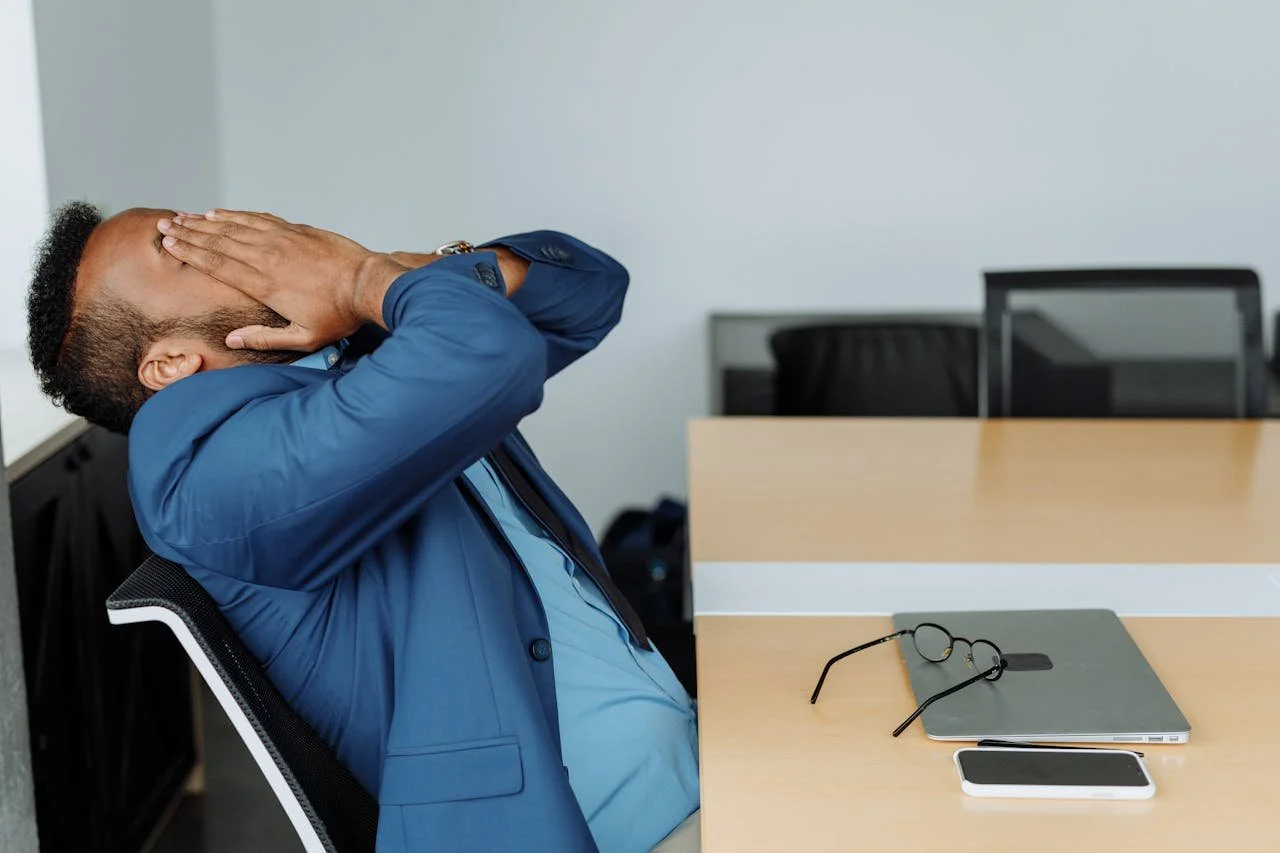
5. Increased Irritability or Emotional Flatness
Changes in emotional response often appear before burnout becomes obvious.
Some executives become short tempered or reactive. Others feel emotionally numb or detached. Both patterns indicate that stress is overwhelming the nervous system.
Emotional changes are not personality flaws. They are executive stress symptoms signalling overload.
6. Loss of Motivation or Enjoyment
When work that once felt meaningful starts to feel heavy or pointless, stress may be the cause.
Loss of motivation is frequently misinterpreted as boredom or dissatisfaction. In reality, it is often an executive stress symptom linked to prolonged pressure and exhaustion.
7. Physical Tension and Stress-Related Aches
Stress is stored in the body.
Executives commonly report:
chronic neck or shoulder tension
headaches
jaw tightness
chest discomfort
unexplained aches
These physical sensations are executive stress symptoms that indicate the body has been in a prolonged state of readiness.
8. Decline in Strategic Thinking
Stress narrows perspective.
Leaders under chronic pressure often shift into reactive mode, dealing only with immediate problems. Creativity and long-term thinking decline. This loss of strategic clarity is a subtle but critical executive stress symptom.
9. Increased Reliance on Stimulants or Distractions
Rising caffeine intake, constant scrolling or staying busy at all times can be coping mechanisms.
These behaviours often indicate an attempt to compensate for low energy or mental fatigue. Over time, they worsen stress rather than relieve it.
10. Feeling Isolated Despite Success
Many executives feel they must carry stress alone.
Leadership can be lonely, and isolation amplifies stress. Feeling disconnected or unsupported is a powerful executive stress symptom that often goes unspoken.
Why Ignoring Executive Stress Symptoms Is Risky
Ignoring stress symptoms does not make them disappear.
When executive stress symptoms are dismissed:
recovery becomes slower
decision quality declines
health issues emerge
relationships suffer
burnout becomes more disruptive
Addressing stress early is far less costly than waiting until exhaustion forces action.
Why Time Off at Home Often Fails
A common response to stress symptoms is taking a holiday or reducing hours.
While helpful, this often does not resolve the problem. At home, executives remain surrounded by:
familiar stress cues
digital access to work
habitual thought patterns
Even when work pauses, the nervous system remains alert. Executive stress symptoms persist because the environment has not changed.
Why Distance Accelerates Stress Recovery
Recovery requires interruption.
When executives step away from their usual environment:
stress triggers weaken
rumination slows
breathing deepens naturally
perspective widens
This is why travel-based recovery is so effective for stress-related exhaustion.
Why Thailand Is a Powerful Recovery Environment
Thailand offers conditions that naturally support stress reduction.
These include:
a warm climate that relaxes the body
access to calming natural environments
a slower cultural rhythm
physical distance from Western business pressures
Many executives notice a reduction in stress within days of arrival.
How Men’s Travel Retreat Supports Stress Recovery
Men’s Travel Retreat specialises in organising recovery-focused retreats in Thailand for stressed executives, businessmen and CEOs.
The retreats are designed to address executive stress symptoms through:
nervous system regulation
structured daily rhythms
breathwork and restorative movement
cold therapy for resilience
guided reflection and clarity
high-quality accommodation and rest
Everything is organised to remove mental load so participants can focus on recovery.
You can visit our homepage here to find out more about us and our retreats by clicking here.
If you have any questions or want to book one of our retreats, please click here!
Executive Stress Symptoms Are a Signal, Not a Failure
Executive stress symptoms are not a sign of weakness. They are signals that sustained pressure has exceeded recovery capacity.
Leaders who listen to these signals early regain clarity, energy and balance before burnout escalates. Those who ignore them often face more severe consequences later.
By stepping into a structured stress retreat in Thailand, executives give themselves the distance and support needed to reset properly. When executive stress symptoms are addressed at their root, leadership becomes clearer, decisions improve and long-term success becomes sustainable again.